Saturday, October 07, 2006

Where's Mini Mona?

( Photo caption: "burp!")
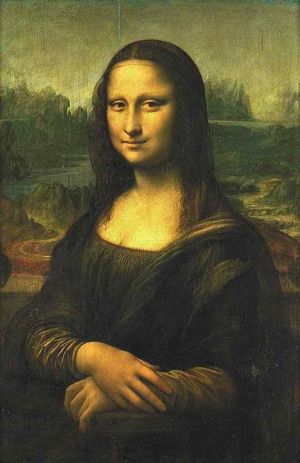
The Mona Lisa by Leonardo Da Vinci is by far the most famous painting ever created. It has a great and amazing history. It was unveiled in 1507, stolen in 1911, recovered in 1913 and some idiot even threw acid on it in 1956. Thousands of legends and rumors surround the portrait, all the way from it's really Leonardo in drag, to the rumor that she's not actually smiling but has gas. Now, Newsweek magazine reports that Mona is believed to be pregnant in the painting. Infrared photography leads scholars to believe that Leo painted a gauzy garment over the Mona Lisa's dress -- the fashion for pregnant women in 16th-century Italy. If this is true, then why haven't we ever seen a painting of Mona's kid? Maybe it explains why she seems to be glowing....and possibly gassy. At the time of this blog, Mona was unavailable for comment.

Friday, October 06, 2006

San Francisco is RUDETOWN, USA!!

( I hope this doesn't sound like a lot of whining. Angelina says it does. But, I'm going to say it anyway!)
San Francisco is one of the rudest places on the planet. Wherever you go, people are rushing around without any concern for anyone else. You see it when you’re driving, especially. People won’t let you change lanes, they will tailgate you to the point where it’s dangerous, and heaven forbid if you somehow upset them on the road, because they’ll flip you off and cuss you out if you so much as glance in their direction. If you’re walking the streets of SF, it’s just as bad. Drivers will not give you the right of way for any reason. They rule the road and you’d better know it. I’ve talked to several SF natives about what’s being referred to as “the Manhattan-ization of San Francisco” and they tell me that it wasn’t always like this. It all seems to have started right after the 1989 earthquake and no one can really say why. I think it’s because no one is from here anymore. Everybody is a transplant from somewhere else and their attitude is “I’m getting mine and f--- you if you get in my way.” Also, in a big city where people live on top of each other, there’s a certain amount of strain due to the close proximity of other supposed human beings. There’s also a real feeling of anonymity here – it’s like “Hey, I’ll never see you again because this city is so big, so I don’t feel like I have to be accountable for my behavior.” Coming from living in San Jose for almost three decades, I’m not used to it. People there are much friendlier, laid-back and courteous. I mean, you’re going to find pockets of nice people and a-holes wherever you go, but I’m talking about the norm. Sometimes I meet people and I am amazed how wonderful they are. It makes me proud to be a part of the human race. Other times I encounter people that make me realize that all we really are is primates with opposable thumbs who beat the rest of the monkeys to the top of the food chain. When I first moved here a year ago from the South Bay, I’d like to believe that I brought with me a friendly approach to life. That’s just my nature. I’d give up shopping carts at the grocery store and let other customers go ahead of me at the checkout stand if they only had a few items, for instance. Now, I don’t do those kinds of things anymore, because, for one, no one says thank you or seems to appreciate it if you do. Cutting folks off in line, ignoring people when they’re trying to get by, snarling at them if you look at them sideways – the citizens of SF are just plain rude! I admit, it’s changed me, but I refuse to become one of them. Welcome to San Francisco, California, aka Rudetown, USA!!

Thursday, October 05, 2006

What the #!&^%(*!! Was That?!?


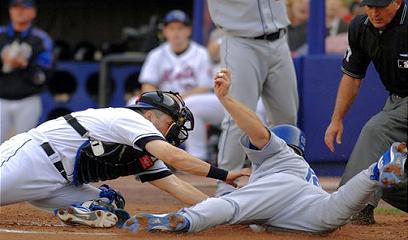
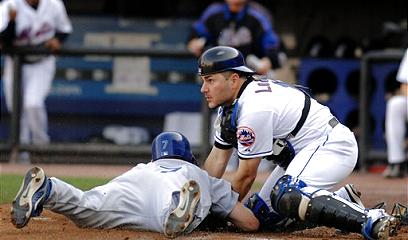
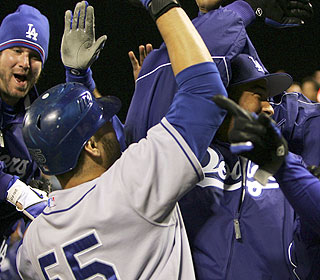
Yesterday in the NLDS series between the LA Dodgers and the NY Mets, the Dodgers made the most boneheaded play I have seen in a long, long time. With zero outs early in the game, both Jeff Kent and J.D. Drew tried to score on a hit by Russell Martin. Kent hesitated, thinking the ball might be caught and Drew got stranded in no-man's land halfway between third base and home. They both got thrown out by a mile! And these guys are supposed to be seasoned veterans who don't make rookie bush league mistakes like that. Kent runs about as fast as my little mutt Ratdog in the mud, and J.D. Drew had no business even thinking about going home. You can time these clowns with a sundial! Instead of having the bases loaded with none out, the Dodgers killed a potentially big inning with really stupid baserunning. In the end, it cost them, because they lost to the Mets 6-5 and are now down 1-0 in the best-of-five series. Most of the time I bleed Dodger Blue, but when they do things like that, I just bleed!

Wednesday, October 04, 2006

Busboys Deserve Our Respect

Busboy Union Proposed by 30-Year Veteran
By R.A. Howard

Gino Arguello, a 54-year old busboy in San Francisco, is aggressively organizing a busboy’s labor union and is quickly gathering support from local busboys as well as waiter’s and chef’s unions and trade groups throughout Northern California.

“Bus persons have been pushed around too long,” Arguello announced at a meeting of over 40 Bay Area busboys on Tuesday. “People treat us like crap and it stops now! Busboys are people too and should not have to feel like second-class citizens. Just because I got like a 350 on my SAT doesn’t mean I’m stupid. I just don’t test well.”

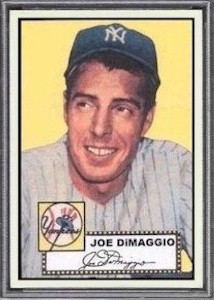
Arguello started out working at DiMaggio’s in the North Beach District of San Francisco in 1976, but was terminated after just one day for allegedly sexually harassing a waitress. “I told her she had a nice set,” he said. “What I meant is that she set the table well. Of course, I was staring at her breasts when I said it. I mean, they were huge!”

Arguello speaks three languages – Spanish, Italian and a form of English that is a mix of Ebonics and shadow puppets. “Sometimes the best way to communicate is to say nothing at all. Gestures and facial expressions can say more than words, know what I’m saying? I also hate it when people talk in fragments. Not cool. No way. At all.”

Arguello has been fired from more busboy jobs than he can recall. His longest tenure was at the Sir Francis Drake Hotel. “They forgot my name, so they couldn’t fire me. Once they tracked down my paperwork, I was gone. But, in the meantime, I lasted more than four months.”

He believes the union will mean better conditions for busboys throughout the state. “For one, we deserve better tips,” Arguello said. “My old boss Vinny used to give me tips all the time, but I don’t bet on the ponies, so what good is that?”

Arguello also believes that busboys take the heat when servers screw up service. “This woman bitch-slapped me one time because she thought I broke wind,” he said. “But hey, it was her waiter, not me. Whatever happened to whoever smelt it dealt it? The union will help us bring that kind of stuff back. It’ll be old school.”

Tuesday, October 03, 2006

My Favorite Neighborhood Bar: The Bus Stop in SF

The Bus Stop
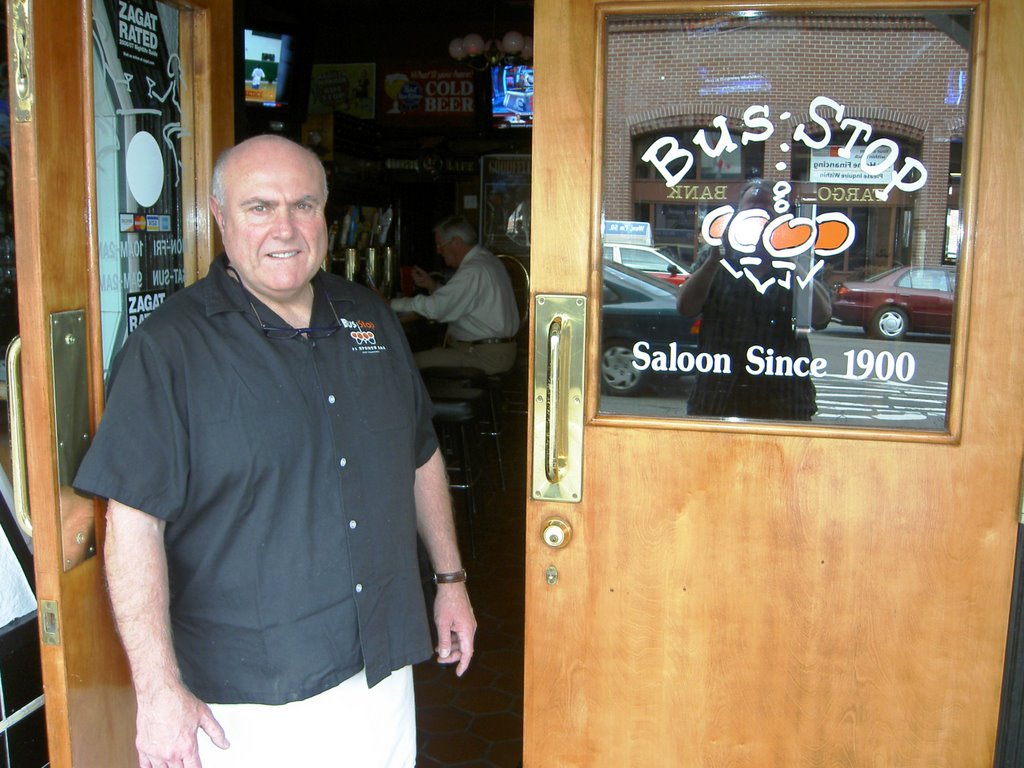
My favorite bar in San Francisco has to be the Bus Stop at the corner of Union and Laguna Streets. It’s a really fun spot that attracts two very different types of crowds, one during the day and another at night. When the sun is shining, The Bus Stop crowd is comprised primarily of locals and working stiffs like firemen, teachers, nurses, cops and plumbers. There is also a group of retired old-timers that come in there during the day. These folks are great to talk to and love to engage other patrons in conversations about everything from sports to movies to politics, even religion. As long as you don’t cuss or get too loud, nothing is taboo at The Bus Stop when it comes to verbal communication. I have walked in on many public debates there, about topics like “Why do the 49ers stink?” to “Did Barry Bonds use steroids?” or “Why the hell can’t we catch Bin Laden?” The week day bartender there is Paulie (pictured above), a San Francisco legend in his own right. He’s originally from Boston, which means The Bus Stop is more of a Boston Red Sox bar than a SF Giants bar. But, Paulie will talk intelligently about pretty much anything that’s on your mind. One of the great things about the man is that he’s also a great listener, something that’s so important with bartenders. I am so tired of bartenders who hog the conversation or don’t care what you have to say. Paulie is the antithesis of this – he’s almost like a very good psychiatrist. He really seems to care about his patrons and I know he does. At night, The Bus Stop transforms into yuppie paradise. The hot chicks come into the place in droves, which of course attracts all of the 20-something male wannabe players from all over the Bay Area. The babes with fake boobs show up in their finest fashion show outfits wearing enough high-priced perfume to make us forget about Chernobyl. They do their very best to ignore all of the guys in the room, until of course they meet the one they want to go home with, at which point they get catty competing with the other hoochies in attendance. It’s very similar to the way moose or lions hook up, except for the credit cards and the Jaegermeister. Watching this mating ritual every single evening gets tiresome, so I go in there after dark only when I have friends in town or if there’s a particularly good baseball or football game I want to watch in a fun atmosphere. The bartenders at night are Ron, Jason and Rick, who are seasoned professionals and really interesting guys. The Bus Stop doesn’t serve food, but they don’t mind if you bring your own in there, either. There are a ton of good restaurants nearby that will deliver grub to you right there. They have two pool tables in the back and approximately a dozen flat screen, high definition TV’s throughout the place. They are also really good at accommodating people who make requests to watch certain games. The Bus Stop has a great Happy Hour every week day after 4 pm, with some very generous drink specials and they have about 10 beers on tap. This bar is one of the oldest and most popular drinking establishments in the city and many people have been coming there for more than 40 years. Their motto is, “A place where friendships are formed to last a lifetime.” And I would add to that, “And where hangovers are created every day.”

Monday, October 02, 2006

Yuletide Yuckfest 2006 Lineup Announced

FOR IMMEDIATE RELEASE
Contact: Ed Attanasio
(415) 595-4555

“Yuletide Yuckfest 2006, a Comedy Benefit, to be held on December 3rd at Rooster T. Feathers to Raise Funds for local Toys for Tots

On Sunday, December 3rd from 7 p.m. to 10 p.m. Rooster T. Feathers in Sunnyvale is hosting “Yuletide Yuckfest 2006,” a comedy show benefiting Toys for Tots and celebrating its ninth straight year. Comics Clinton Jackson, Jacob Sirof, Gretchen Rootes, Carla Clayy, Dan St. Paul, Nick Leonard, Hymie Laredo and many special guests will converge on the stage at Rooster T’s to make people laugh for a worthy cause. Also featured will be music by the band “Chubby’s All-Stars,” with special guest Viv Savage, former keyboard player for the famous band, “Spinal Tap.” Admission is $10.00 and an unwrapped toy, or $15.00 without one. Doors open at 7:00 p.m.
Hymie Laredo, whose real name is Ed Attanasio, will host the big event. He sees the show as a chance for comedians to give back to the community, by providing new toys for those less fortunate.
“There is just something about giving kids toys that makes me happy,” Attanasio/Laredo said. “My niece needs a storage locker just to keep all the toys I’ve given her over the years. It’s the little kid in me. It probably makes me feel better than it does the children. I guess Santa Claus must be somewhere down the line on my family tree.”
The comedians featured have been on Comedy Central, VH1, the Comedy Channel, Nickelodeon, the Tonight Show, and more.
Rooster T. Feathers is located at 157 West El Camino Real in Sunnyvale, next to Goodyear Tires. Ample free parking is available. Rooster T. Feathers’ phone number is (408) 736-0921.

Sunday, October 01, 2006

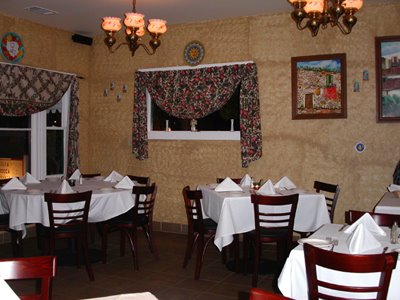
Restaurant Review: Sicilia in Bocca: Great Italian Food in Morgan Hill


Is Sicilia in Bocca in Morgan Hill one of the best Italian restaurants in the South Bay? Fuggetaboutit! It’s the whole package when it comes to great dining – a fun, relaxed atmosphere, wonderful food and an owner who is passionate about every little detail.

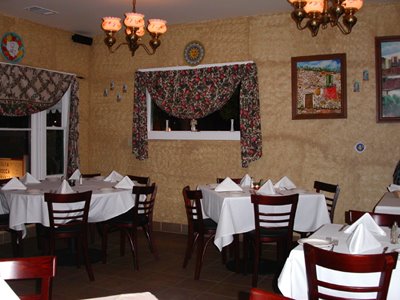
I have been to Sicilia in Bocca (which literally means “Sicily in Your Mouth”) a dozen times, and every visit is just as memorable and pleasant as the last. Just off Monterey Road and directly behind the Morgan Hill Police Department, Sicilia in Bocca is located in a Victorian-style home that has been converted into a quaint, intimate restaurant that seats about 35. Approximately15 tables fill the dining room, and when weather permits, you can eat outside on the patio as well.

Tony is the owner, and no – his last name is not Soprano. It’s Graziano, like the famous prizefighter, which is fitting because this Tony used to actually fight in the ring. And although he's not a large man by any means, he looks like he’d be able to hold his own in a tussle. He also has a soft and very endearing side, and just talking to him, you can feel the love and conviction that he has for his establishment and his food.

Tony came to the United States in 1972 from Palermo, Sicily, working primarily in the restaurant business. His mentors along the way taught him well, including top-notch culinary maestros like Frank Sinatra’s personal chef. In October 2000, Graziano fulfilled his lifelong dream of opening his own restaurant. Sicilia in Bocca was born.

At Sicilia in Bocca, the food is without a doubt the main attraction, but Tony is a marvelous sideshow to be sure. Just listening to him describe his daily specials will have you drooling like one of Pavlov’s dogs. He also enjoys introducing diners to each other, creating a fun and comfortable atmosphere where everyone is interacting. Some patrons enjoy touring the kitchen, which Graziano encourages. If something isn’t on the menu, you can ask for it, and if the ingredients are on hand, Tony is always more than happy to oblige.

But, I must warn you. If you’re looking for your standard Italian faire – like lasagna and pizza, for example – Sicilia in Bocca may not be for you. This is real Italian cuisine, created and served by a man who grew up there and learned at age 15 how to cook from his mother. Everything Tony creates is made with the freshest produce, meat, poultry and seafood. He shops every morning for organic vegetables for his soups and salads, and only buys fish that has just recently stopped swimming. All of his pastas are made from scratch, and he even makes his own lemon liqueur.

The other night, my family and I started off the evening with a classic caesar salad ($6.00). It was in a word, bellisimo. The romaine lettuce was crunchy and the salad was not over-dressed, a common snafu when it comes to some caesars. We also had an incredible minestrone soup ($4.00/cup or $7.00/bowl) that in itself could have been an entire meal.

The main courses we ordered consisted of a fresh fish special of sautéed sea bass topped with capers, olives and tomatoes, accompanied by a pair of polenta squares (market price/just ask); a pasta dish called Pappardelle alla Modicana, ($12.00) a sausage and ricotta cheese creation with a fresh tomato sauce, and a scene-stealing meat entrée, called Medaglioni ai Funghi Porcini, ($19.00) beef medallions sautéed with dried porcini mushrooms, rosemary and a red wine demiglaze sauce. Each dish was exciting and different with a distinct blending of tantalizing flavors and textures.

Sicilia in Bocca is open for lunch Tuesday through Friday from 11:30 a.m. to 2:00 p.m. and for dinner Tuesday through Sunday, starting at 6:00 p.m. Reservations are required for parties of more than four people, and although he says he closes at 10:00 p.m., if there are still hungry people at the door, Tony will stay open.

Sicilia in Bocca has a great wine list, featuring a wide variety of whites and reds from Northern California and the Old Country. And the desserts, like the gelatos served in fruit bowls, are a complete delight. The address is 25 West Main Street in Morgan Hill. For reservations, call (408) 778-0399.

The fact is that Sicilia in Bocca is Tony Graziano. And that’s probably what makes this place so unique and special. The man puts his heart and soul into every aspect of the restaurant and stands behind it with extreme pride and unbridled enthusiasm. You can see it in his smile and in his twinkling eyes. You can feel it through the atmosphere and ambience that he’s created. And you can surely taste it in his outstanding food.

I can’t recommend Sicilia in Bocca enough. How much do I like this place? Let’s put it this way -- I dream about this food when I sleep at night. I always look forward to eating there again and to seeing Tony Graziano once more.
Saturday, September 30, 2006

I Smell Playoffs!

I went to the LA vs. SF game last night at AT&T Park and saw the Dodgers pull out a rare ninth inning victory over their hated rivals. The Dodgers have a legitimate shot at making the playoffs now. If they can beat the Giants today or if the Philadelphia Phillies lose this morning, they are assured a spot in the postseason as a wild card entry at the very least. The also have a chance to win the NL West, because they are now tied with the San Diego Padres. Last night, the Giants' fans were out in droves, cheering wildly at a sold out game. The orange and black squad was eliminated from the playoff picture last week, so all they're really rooting for at this point is the opportunity to knock the Dodgers out of the playoffs. In a way, I think that's kind of pathetic. It has to be an empty feeling for Giants' fans. It's like, "We've failed, so now we're going to find joy in spoiling it for you." The bottom line is that the Giants and their fans are going to be watching the playoffs on TV, while the Dodgers have a very good chance of continuing their season. I'm not too confident that the Blue Crew will do very well in the postseason -- Nomar Garciaparra looked like he was really hurting last night and one of their best starting pitchers, Brad Penny, is injured -- but at least they'll be there. There was this one Giants' fan sitting right in front of us last night, and every time we cheered for the Dodgers he turned around and gave us the nastiest look. It was like we had farted or something! He kept doing it and it was so annoying. In the old days I probably would have gotten it into him, but the new Ed just stared right back at the clown. Some people! Anyway, I got to meet Keifer Sutherland and Orlando Cepeda at the game last night, which made the whole evening that much more fun!
Go Dodgers! Win it today!

Friday, September 29, 2006

Fifty Years By the Bay to be Released Next Month


(Chuck Nan is a good friend of mine and an awesome sportswriter. I met him a few years back at a Society for Baseball Research meeting at McCovey's Sports Bar in Walnut Creek. He is releasing a book called, "Fifty Years By the Bay" in mid-November. I helped him edit it and I can tell you it's the most complete and definitive history of the SF Giants that I have ever seen. To find out more about the book, visit www.fiftyyearsbythebay.com. I smell a best seller!)

Here is a bio on sports journalist and author Chuck Nan:

Chuck Nan is a sports journalist and broadcaster in the Bay Area. Nan received his Bachelor’s Degree in Finance from Loyola Marymount University in Los Angeles. For many years, he worked in the financial services industry, holding positions in operations, customer service and project management.After a successful business career, Nan started his own firm, SportsQuest Tours that specialized in fan travel to sporting events worldwide. He also served as Media Relations Director, and co-hosted several popular shows, for a local all-sports format radio station, covering all of the local professional and college teams and many high profile sports events.Chuck has recently turned to the written form of sports journalism. He is the Sports Editor for his hometown paper the Martinez News-Gazette. His first formally published piece was entitled “San Francisco Giants Spring Tour of Japan, March 1970” in Elysian Fields Quarterly-The Baseball Review in summer, 2004. Chuck has also had smaller articles published by SABR (Society for American Baseball Research) in their annual releases, The Baseball Research Journal and The National Pastime.Nan is also involved with youth baseball as a coach, instructor and administrator. In the past years, Chuck has worked with the San Francisco Giants Youth Baseball Summer Camp and EJ Sports, run by former Giants’ players, Rob Andrews and Erik Johnson, respectively and BayArea Baseball of Hayward. He has also worked with the baseball program at Alhambra High School in Martinez.A true native of San Francisco, Chuck grew up just 10 minutes from Candlestick Park. The Giants were his first sports love at age six, and still are. He has been a season ticket holder for many years and seen several hundred games in his life. Chuck has spent many a frigid summer night at the ’Stick watching his beloved team.Nan resides with his family in Martinez, California.

Thursday, September 28, 2006

What a Dream Gig!


(This is an article I found on www.msn.com called, "The Secret Lives of a Baseball Card Writer -- I Worked for Topps and Lived to Tell About It" by David Roth. My first reaction upon reading it was, wow -- what a great job that must be. I am an absolute baseball nut and have a baseball site called www.thisgreatgame.com. I interview retired baseball players throughout Northern California for SABR (www.sabr.org). When I was a kid, I had a collection of approximately 20,000 baseball cards that took up half the space in my closet. I spent countless hours looking at them and reading the text and statistics on the back of each card. When I was in college at San Jose State, I sold them all for a pittance to some guy who must have been secretly drooling. This was around 1980, right before the big baseball card craze hit. I hate to think what those cards would be worth today. I hope whoever has them is enjoying them as much as I did in 1969!)

Here's the article:

As a child, when I had what might be called a serious baseball card habit, I looked forward to a new year of Topps baseball cards in a way I looked forward to nothing else. In the way things happen when you're a kid, baseball, basketball, and football cards took on an outsized importance in my life. And then, in the way things happen when you're a slightly older kid, cards just stopped mattering to me. I forgot about them for 15 years.
Topps became real to me again thanks to some basketball cards my roommate left around the apartment. Deep in the doldrums of underemployment, I started flipping through them while enjoying an afternoon beer. Inspired by the text on Vitaly Potapenko's 2001 Topps card (his teammates had nicknamed him "Eddie Munster") and with a courage assist from Miller High Life, I sent Topps my résumé. I figured that would be the end of it, but I got an e-mail in response. They asked how I would describe my interest in and knowledge of sports; I answered "freakish/obsessive." I got an interview, and then I got the job.
Starting a job at Topps was stressful. I was about to enter, as an adult, a place I'd always imagined as a gum-scented, Willy Wonkafied dream palace. Before my first day of work, I pictured packs piled in leaning towers, slides from long-ago Darryl Strawberry photo shoots, game-worn Mickey Tettleton jerseys. When I showed up, I found a standard corporate office: cubicles, recycled air, bad carpeting, worse lighting. There was plenty of candy—Topps makes Ring Pops, Push Pops, and Bazooka bubble gum—but few cards in sight. There was little indication that this place churned out baseball cards and not, say, bath mats.
My job was to edit the text and statistics for the card backs. These came from a Virginia-based head writer named Bruce Herman (author of the Potapenko card that led me to Topps) and a Quebecois statistician named Nicolas Chabot, respectively. I did ordinary editor things—assigned text, edited it for accuracy and aesthetics, drew elaborate geometric doodles at meetings—but was buoyed by the fact that I was doing these in a not-so-ordinary environment.
While the text was inescapably repetitive, the stuff I edited was certainly better than the "Hector's hobbies are eating and sleeping" non sequiturs that made up the Topps backs of my youth. Today's cards top out at 400 characters (including spaces), or about 70 words, and usually take the shape of punchy feature articles. My favorite was a card for the St. Louis Rams' Harvard-educated backup quarterback, Ryan Fitzpatrick. The back text dealt with a question posed to him by his offensive line. Figuring that perhaps he'd covered this in Cambridge, they asked Fitzpatrick what would hurt more: getting kicked by a donkey or whipped in the face by an elephant's trunk. Fitzpatrick went with the elephant slap. Bruce provided a source, and I checked it. All true. At times like that, the job was something very close to fun.
Tight deadlines created tension, but it's hard to stay stressed when your bosses are pestering you for 50 words about some punt returner's hobbies. Sadly, though, the same things that bothered me about previous corporate gigs were easy to find at Topps. Upper management was a distant, nepotistic network descending from a mysterious, largely invisible septuagenarian CEO. Below that, departments feuded with other departments. Middle managers skirmished in snarky, caps-locked e-mails CC'd to higher-ups. "Good mornings" seethed with passive aggression.
My co-workers and I shared a sense that our contributions were undervalued. My job's irrelevance—I worked on the less glamorous back half of the card, you see—was confirmed through my absence from the card-distribution rolls. At Topps, the haves receive free boxes of each new product. The have-nots, like me, do not. When I asked for boxes of the products I'd worked on, I got brushed off. Eventually, I gave in and queued up at the company store along with copy editors from the quality-assurance department.
I was frustrated not only because this wasn't what I'd expected—who even has company stores anymore?—but because a myth from my childhood got sullied. Baseball cards, it turned out, are not made in a card-cluttered candy land. Rather, they are created by ordinary men and women who are generally unawed by their proximity to a central part of American boyhood.
Neither trading cards nor "novelty candies" have been breaking any sales records recently. Consequently, Topps has banked increasingly on ultra-high-end trading cards. The company's most expensive "pack," the beautiful, autograph-laden Topps Sterling, comes in a cherry-wood box and costs $250 for five cards. While those cards make money—as, it should be said, do the basic $1.50 packs—the trading-card business has been more or less moribund for a decade. So, it wasn't a total surprise when I was laid off in July, effective mid-September.
I'm glad I got the chance to work at Topps, if only because it was fun to tell people at parties that "I'm in the baseball card business." My Topps experience also helped me remember why collectors collect. It's the hunt for what the brand managers call "white whale" cards. I know it's awfully literal, but mine is the Herman Melville card I wrote for Topps' Allen and Ginter set. That's a new product—scarce around the office, not sold in the company store, $5 a pack in card shops—in which Gilded Age cultural figures mingle with the A-Rods and Nick Puntos. Odd, I know, but I love the set.
Before I left for good, I found what I'd been searching for. It was behind a locked door, which was itself behind an ordinary-looking backroom. I flipped the switch, and lights flickered on overhead, revealing a back-backroom awash in cards. Binders lined the walls, filled with every card in every Topps baseball and football set from the 1950s through the 1990s, all pasted—why?—to white three-hole-punch paper. To get to those shelves, I had to step on and over boxes brimming with loose cards and cards in bricklike 500-count vending boxes. And that was just the cards. A box fell off a shelf and baseballs autographed by Frank Robinson rolled out. Jerseys that were to have been cut up and inserted into "relic" cards gave one dusty corner the look of a chaotic locker room. A box of bats inscribed with the names of journeymen such as Geronimo Berroa and Ron Coomer sat in another.
This back-backroom would not have looked like much to most people. I was relieved, though, to discover that the baseball card wonderland I'd dreamed of was somewhere in that office after all.